
What is Perplexity?
Perplexity builds an answer-oriented alternative to link-first search, aimed at people who want a synthesized response and sources to investigate. Its developer platform also exposes web-grounded answers, ranked search results and embeddings for applications. That makes it relevant both as a research interface and as a supplier of search infrastructure, rather than only as a conversational assistant.
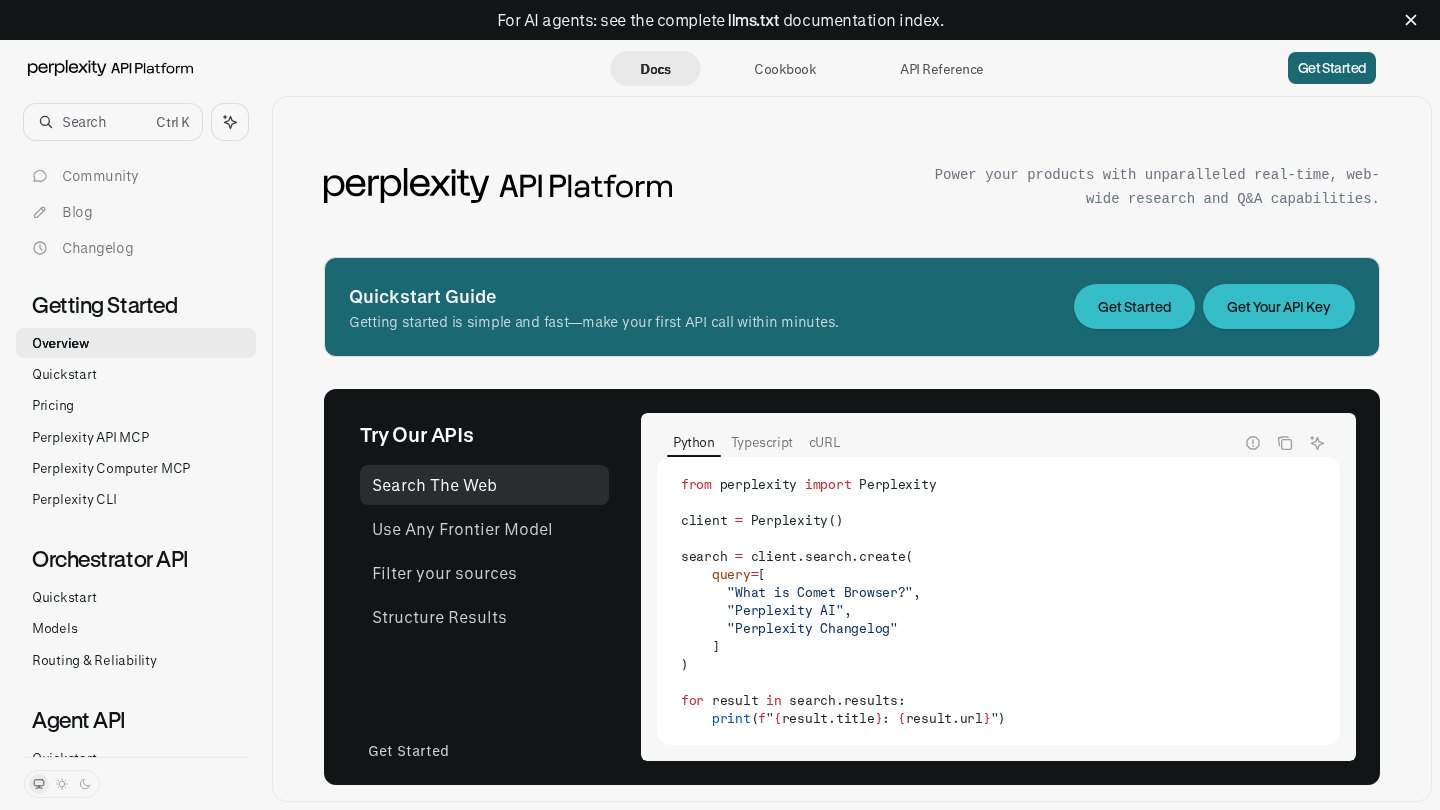
Key features
- Source-cited answers
- Web-grounded developer API
- Ranked search results API
- Embeddings for retrieval
- Access to third-party models through the Agent API
Focus areas
- Background research
- Source discovery
- Search-enabled application development
- Retrieval pipelines
Who it suits
- Researchers and analysts
- Developers building search-backed tools
- Knowledge workers comparing sources
Who may not need it
- Users requiring guaranteed factual answers without source review
Integrations and compatibility
- OpenAI-compatible Orchestrator endpoint
Where it fits in a workflow
Use it to gather leads and assemble an initial research brief, then open original sources before publishing or making decisions. Developers can use ranked search when they want to control synthesis themselves.
Sources
Strengths
- Citations provide a route back to supporting material
- Separate search and answer APIs suit different application designs
Watch-outs
- Citations still need checking against the underlying claim
- Application builders must choose between raw retrieval and generated answers
Peers
Related coverage
ChatGPT vs Perplexity: Assistant or Answer Engine?
Compare ChatGPT and Perplexity by the work you need done: finding evidence, creating drafts, checking claims, and handling sensitive information.
GuideHow to Evaluate and Compare AI Research Claims
Compare AI results without confusing benchmark wins with practical value. Build a fair evidence table and a task-specific evaluation plan.
ReviewPerplexity Review: Plans, Strengths and Who It Suits
Perplexity turns questions into search-based answers with sources. Here is how to judge its research workflow, limitations and subscription fit.
GuideA Practical Checklist for Choosing an AI Workflow
Turn an AI idea into a bounded pilot with clear inputs, review steps, ownership, and stop rules.
GuideA Starter Guide to Writing for Answer Engines
Write useful answers without flattening your expertise. Learn how to define the question, support claims, and build a small editorial experiment.
GuideHow Large Language Models Work: A Simple Guide
Understand tokens, training, context windows, and why fluent AI responses still need factual checks.
Listings are editorial and independent. Details that change often are marked “to be verified” until an editor checks them against the official source.