
Building a business model means connecting a customer need to an operation that can deliver value and sustain itself. This guide shows how to create a usable first version, calculate simple economics, and revise the model with evidence rather than treating it as a finished slide.
How Do You Build a Business Model?
Start with a specific customer and problem, then map the offer, route to market, delivery requirements, revenue, and costs. Make the dependencies and uncertain assumptions explicit. Test the most consequential uncertainties with a small, ethically run pilot, and update the model using actual buying and delivery behavior.
1. Define one customer and one important problem
Why: A model built for “everyone” makes it difficult to decide what to offer, how to reach buyers, or which costs matter. A narrow first customer definition makes the rest of the design more concrete.
How: Describe a reachable group with a common problem, current workaround, and reason to act. Identify the user, buyer, and budget owner where these differ. Write the problem in the customer's language rather than naming a feature you want to build.
For example, “independent repair shops that lose time preparing job estimates” is more actionable than “small businesses needing digital transformation.” You can investigate how estimates are prepared, who approves software, and what the delay costs in practice.
Use conversations, observation where appropriate, and available market information. The SBA's market research guidance provides a starting point for examining customers and competition. Include existing workarounds, including spreadsheets or doing nothing, rather than counting only direct product competitors.
Write a value proposition as a proposed result for that customer. Avoid unsupported superlatives. “Help repair shops prepare consistent estimates with less repeated data entry” is a testable promise; “the best platform for every shop” is not.
Record what you know and what you assume. A customer's complaint is evidence of frustration, but it does not by itself prove willingness to pay for your particular solution.
2. Map how the value will reach the customer
Why: A useful product does not automatically produce a viable business. Customers must discover it, trust it, buy it, receive it, and keep getting the promised benefit.
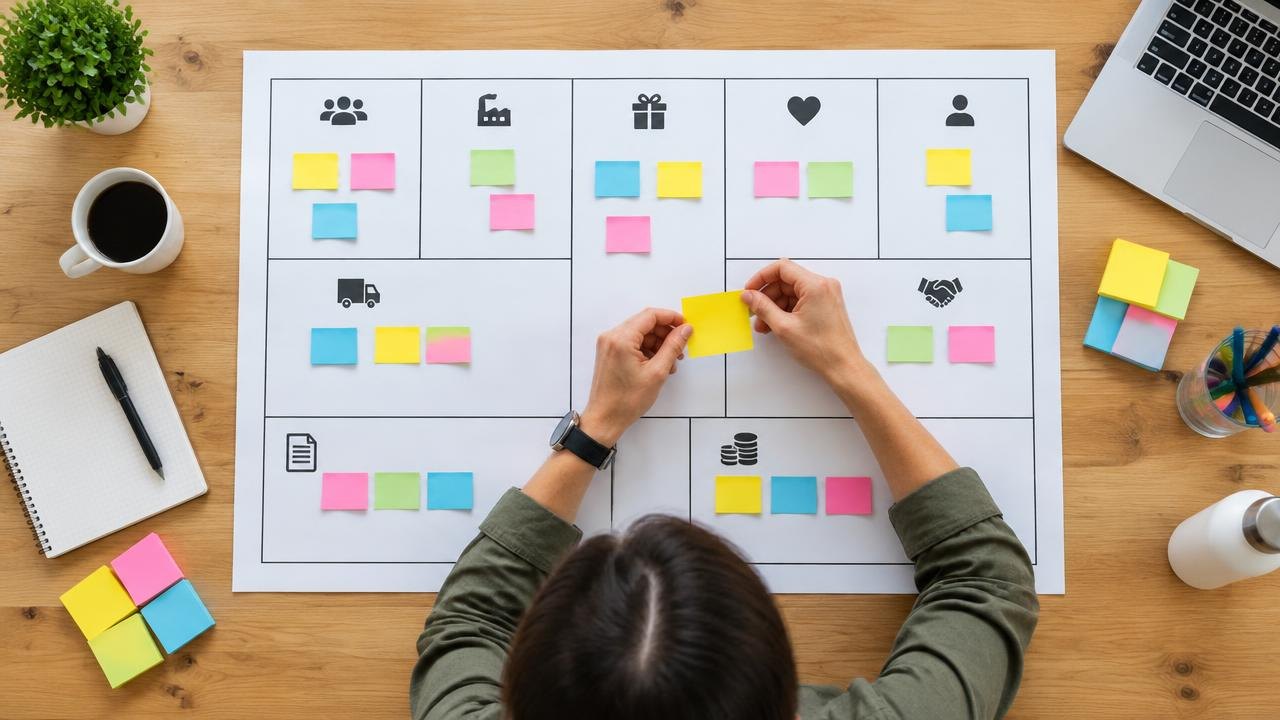
How: Build a one-page operating map. The Strategyzer Business Model Canvas organizes related elements such as customer segments, value propositions, channels, relationships, activities, resources, partners, revenue, and costs.
Use the map to expose connections, not to fill boxes with attractive phrases.
| Element | Question to answer | Evidence to seek |
|---|---|---|
| Customer | Who experiences and pays for the problem? | Interviews and actual buying processes |
| Value | What useful result is promised? | Demonstrated use and customer feedback |
| Channel | How will qualified buyers find and purchase? | A small, measurable acquisition test |
| Relationship | What help supports adoption and continued use? | Onboarding effort and support needs |
| Delivery | Which activities and resources are essential? | A real fulfillment walkthrough |
| Partners | What depends on another organization? | Availability, terms, and alternatives |
| Revenue and costs | What is charged and what must be spent? | Paid transactions and observed expenses |
Trace one customer's journey from first contact to successful use. Include handoffs, payment, data access, setup, and support. A gap between purchase and actual use can reveal a missing activity or an unrealistic staffing assumption.
Do not confuse a channel with a guaranteed source of customers. “Social media” is not an acquisition plan until you know whom it reaches, what action they take, and the effort required to obtain a suitable buyer.
3. Design the revenue and delivery rules together
Why: A price that appears attractive can become unsustainable when delivery includes unlimited customization, support, or revisions. The scope of the promise and the method of payment need to fit each other.
How: State what customers receive, what triggers payment, what is included, and what is outside scope. Identify any recurring obligation. Use clear language for trial periods, billing, cancellation, and changes in service.
Choose a revenue mechanism as a working assumption rather than an identity. A service might charge per project, per month, or by measured usage. The important question here is how that mechanism connects to real work and customer value.
For a service business, record delivery hours and revision expectations. For a physical product, include sourcing, packaging, shipping, defects, and returns. For software, include onboarding, infrastructure, payment fees, support, and the work required to keep the offering dependable.
Partners can provide important capabilities, but they also create dependencies. Identify what happens if a supplier raises prices, an integration becomes unavailable, or a channel changes its rules. A single attractive partner agreement should not hide a fragile delivery chain.
Make ownership explicit. Someone must be responsible for sales handoff, fulfillment, customer questions, and financial records, even when the same founder initially performs every role.
4. Build a simple economic and cash model
Why: Revenue alone cannot tell you whether the model can sustain operations. You need to understand variable costs, fixed costs, and when cash is collected or spent.
How: Start with a modest spreadsheet covering a defined period. List the unit sold, price, expected volume, variable cost per unit, and fixed operating expenses. Keep assumptions visible instead of burying them in formulas.
The SBA's startup-cost guide helps identify initial and ongoing expenses. Its business-plan guidance also connects planning with the financial and operational structure of a business.
Consider a hypothetical workshop service charging $200 per session. Assume each session requires $80 of instructor time and $20 of materials and transaction costs. The contribution per session is $100 before fixed expenses and any costs not included in those assumptions.
If hypothetical fixed monthly costs are $1,000, ten sessions cover those costs on this simplified basis: $1,000 divided by $100. That is a contribution break-even calculation, not a promise of take-home income. Taxes, financing, capacity limits, acquisition costs, and unexpected expenses may change the result.
Now inspect cash timing. If customers pay after delivery while instructors and suppliers must be paid earlier, the business needs cash to bridge the gap. A model can look profitable over a month while lacking money on a particular payment date.
Build a downside scenario with lower sales, higher delivery effort, or slower collections. If a small deviation makes the model unworkable, treat that fragility as a design problem to investigate before expanding.
5. Test the assumptions most likely to break the model
Why: Not every uncertainty deserves equal attention. A beautiful brand or elaborate automation will not fix a customer who does not value the offer or delivery that costs more than the price.
How: List the assumptions and rank them by consequence and uncertainty. For each important one, define the evidence that would change your decision. Then choose the smallest responsible test capable of producing that evidence.
A conversation can test whether the problem is understood, but it does not confirm paid demand. A transparent paid pilot can provide stronger evidence about purchase and delivery, provided customers understand the scope and any limitations.
Measure the entire process. Record how suitable prospects were found, what they paid, how long onboarding took, what delivery actually cost, and whether the promised result was achieved. Do not count only the steps that support your preferred conclusion.
Set boundaries before the pilot. Decide the maximum time or money at risk, the customer safeguards, and the conditions under which you will stop. Avoid promising a mature service when you are still testing a limited manual process.
For the hypothetical workshop, a pilot might reveal that preparation takes twice as long as expected. That finding could justify a different scope, better reusable materials, or a higher price. It should not simply disappear from the spreadsheet because it makes the initial model look worse.
6. Turn learning into an updated operating model
Why: A business model becomes useful through revision. Treating the first version as a commitment can encourage teams to explain away evidence instead of responding to it.
How: Keep a dated change log. Record the original assumption, the observed result, the decision, and the next question. Review changes across the whole model: a higher-touch offer may improve results but also require a different price and acquisition approach.
Monitor a small set of relevant measures. These might include qualified inquiries, paid conversion, contribution per sale, delivery effort, repeat purchases, retention, and collection time. Definitions matter more than the number of dashboard widgets.
If customers leave quickly, investigate before concluding that price alone is responsible. Poor fit, unclear expectations, weak onboarding, seasonal demand, and service quality are alternative explanations. Use interviews and operational evidence together.
Scale only when the important parts are sufficiently repeatable for the next stage. Early success with a founder personally handling every exception does not yet demonstrate that a larger team can deliver the same economics or experience.
Questions About Building a Business Model
Do I need a formal business plan first?
Not necessarily. A one-page model can help organize early assumptions before a longer document is useful. Financing, partners, or internal governance may require a more detailed plan. Keep the two consistent rather than treating them as separate stories.
What if the user and the payer are different?
Map both explicitly. You need a useful experience for the user and a credible reason for the payer to approve spending. Also identify anyone who can block adoption, such as procurement or an operational owner, without assuming all stakeholders share one definition of value.
How often should I update the model?
Update it when meaningful evidence changes an assumption, and schedule regular reviews suited to your sales and delivery cycle. Avoid changing everything after one unusual customer, but do not wait for an annual planning exercise to address a clear recurring problem.
Test How the Business Creates Value
A working business model connects a specific customer problem to a deliverable promise, reliable operations, and sustainable economics. The first version is a set of linked assumptions; the useful version is the one you keep checking against real behavior.
Next steps: Revisit how to choose a business model, compare modern model patterns, or browse the business models hub.
Sources
- Strategyzer — Business Model Canvas
- U.S. Small Business Administration — Market research and competitive analysis
- U.S. Small Business Administration — Calculate your startup costs
- U.S. Small Business Administration — Write your business plan
This guide is general education, not professional business, financial, or legal advice.